For the first time in history, Meta is set to out-earn Google in global advertising. This isn’t just a revenue story — it’s a realignment of where digital power lives.
Google has dominated digital advertising for nearly two decades. It built the internet’s most powerful revenue engine on the back of search — the moment consumers reach for answers, Google was there to sell the next click. That reign is ending.
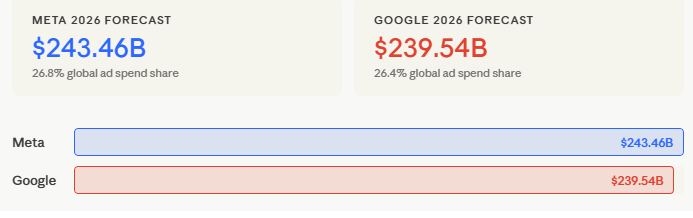
In 2026, Meta is projected to generate $243.46 billion in ad revenue against Google’s $239.54 billion. The gap is narrow, but the direction is unmistakable. Advertisers are voting with their budgets — and they’re voting for performance, automation, and social scale.
“Meta overtaking Google is more than symbolic. It marks a fundamental shift in where digital power lives.”
Why Meta is winning
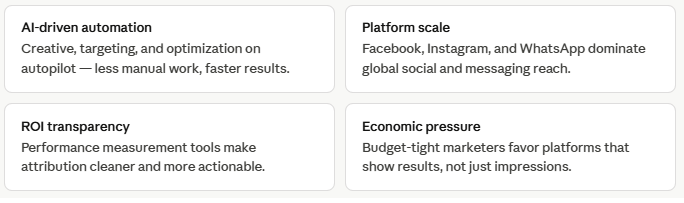
Three forces have converged in Meta’s favor. First, its AI-powered ad tools have dramatically reduced the manual burden on advertisers. Creative generation, audience targeting, and bid optimization are increasingly automated — making it easier and cheaper to get results. Second, Meta’s platforms — Facebook, Instagram, and WhatsApp — command a combined global reach that no competitor can match in social. Third, in a cost-conscious economy, marketers are demanding measurable ROI. Meta’s performance tools deliver that clarity better than most.
What’s slowing Google
Google isn’t stumbling — $239.54 billion is still a historic number. But its core business is under pressure from multiple directions. Search ad growth is plateauing. AI-powered search experiences are disrupting the traditional paid-search model. And mounting antitrust scrutiny in the US and EU is adding regulatory drag. Google’s dominance in search and YouTube remains intact, but the growth story is slower and more complicated than it used to be.
The risks neither side can ignore
Meta
Deep reliance on AI automation raises real privacy and transparency concerns. One regulatory crackdown could disrupt its entire targeting infrastructure overnight.
Slowing search ad growth, AI-driven search disruption, and antitrust pressure create a compounding headwind that’s difficult to offset quickly.
Marketers
Overcommitting to either platform is dangerous. Platform dynamics are shifting fast, and budget flexibility is no longer optional — it’s a survival skill.
What this means for your media strategy
The practical takeaway for marketers isn’t to abandon Google — it’s to stop defaulting to it. Google remains essential for search intent and YouTube’s video dominance. But Meta should no longer be treated as a secondary channel. For performance-driven campaigns, it’s now the benchmark.
Smart budget allocation in 2026 means testing aggressively on Meta’s AI tools while maintaining Google presence for search and upper-funnel video. The brands that will win are those that treat both platforms as tier-one investments — not a primary and a backup.
The bottom line
Meta surpassing Google in ad revenue is a signal, not just a statistic. It tells us that automation, measurable performance, and social scale now outweigh the gravitational pull of search intent. For marketers, the mandate is clear: rethink your default allocations, embrace platform flexibility, and don’t let legacy assumptions determine where your next dollar goes.

